


Project Portfolio
MEMS Design: Anemometer
Project: ENGR 406 MEMS Project
Date: April 30, 2026
Collaborators: Brett Bittner, Isaac Moore,
Carter Jardine
Project Overview
This project explored Micro-Electro-Mechanical Systems (MEMS) to create a hot wire anemometer.
-
Functionality: It measures airflow speed over the wires using the variability of the convection coefficient, which is proportional to the resistance in the wires. Resistance was measured using a National Instruments DMM USB-4065. The data collection was done using MATLAB.
-
Design: The design featured resistive wires lifted from a substrate to minimize reverberatory noise, positioned to measure flow traveling parallel to the substrate.

Figure 1: Anemometer Video Report
File 1: Project Report
Soft Robotics Design
Project: ENGR 382 Final Project
Date: April 25, 2026
Collaborators: Carter Jardine
Project Overview
The objective of this project is to design, build, and validate a soft robotic end effector capable of twisting open a standard bottle cap in a controlled and reliable manner. This system integrates core principles of soft robotics and mechanical design learned in biomedical engineering.
Skills Developed
-
Soft robotics design and compliant mechanism development
-
Pneumatic and actuator-based motion systems
CAD modeling and rapid prototyping workflows -
Material selection for flexibility, durability, and deformation control
-
Mechanical design iteration and experimental testing

Figure 2: Soft Robotics Video Report
File 2: Project Report
File 3: Engineering Drawing Package
Tissue Engineering: Liquid Hydrogel Dressing Device
Project: ENGR 495 Final Project
Date: April 30, 2026
Collaborators: Iker Urtega
Project Overview
Designed a bioactive wound dressing system for burns, abrasions, and avulsions. The device is designed to deliver a fibrin-based polymer solution containing mesenchymal stem cells and FGF-2 growth factors, which solidifies directly on the wound surface in response to naturally released calcium and factor XIII. We also designed a biomimetic skin model to evaluate scaffold performance, hydrogel polymerization, and tissue regeneration potential, without relying on animal testing.
Key Skills & Knowledge Developed
-
Biomaterials selection and hydrogel scaffold design
-
Controlled drug and growth factor delivery strategies
-
Stem cell integration in biomedical devices
-
Biomedical device prototyping and experimental design
-
Understanding of wound healing physiology and biocompatibility
-
Translating biological mechanisms into engineering solutions
-
Technical documentation and scientific communication
-
Systems-level thinking for medical device development
-
Research and development workflow experience for biomedical applications

Figure 3: Liquid Hydrogel Dressing Design and Testing Apperatus
File 3: Project Report
Manufacturing Processes: Model Train Cannon
Project: MANF 377 Final Project
Date: December 12, 2025
Collaborators: Joshua Worsley-Brown, Mason Schroeder, Luke Parnitzke, Lara Ranasinghe
Project Overview
This project involved the design and fabrication of a model train equipped with a cannon assembly. The objective was
to apply various manufacturing techniques to create a
functional, assembled prototype.
Manufacturing Processes Used
-
Waterjet Cutting: Used for the train base and side walls.
-
Milling: Employed to create flats and internal cutouts.
-
Lathe Turning: Used for the wheels, axles, and the cannon cylinder.
-
Drill Press: Utilized for drilling and tapping holes for bolts, axles, and the hitch.
.jpg)
.jpg)


Figures 2-5: Shop Drawings
Design of Machine Elements: Single-Stage Reduction Gearbox
Project: ENGR 380 Term Project
Date: April 11, 2023
Collaborators: Nathan Dong, Sahil Gupta, Scott Halston, Harshil Chauhan, Gurkirat Dhamija, Julian Alviento
Project Overview
The goal was to design a single-stage reduction gearbox for a vessel propulsion system. The system was required to reduce an input speed of 1750 RPM to an output speed of 500 RPM while maintaining 25 HP.

Figure 8: SolidWorks render

Figure 7: Expanded View of gearbox assembly
Design Specifications
-
Materials: 40 Cast Iron for gears to balance cost and machining characteristics; 1045 Hot Rolled steel for shafts.
-
Gears: 63-tooth main gear with a 300 helix angle and a 10.13-inch center distance.
-
Safety Factors: Achieved a fatigue safety factor of 2.5 for shafts and met all bending and surface safety requirements for gears.
Materials Engineering: Alloy Selection and Carburization
Project: ENGR 376 Final Project
Date: December 7, 2023
Project Overview
The project focused on selecting an optimal steel alloy and
designing a carburization process for a gearbox application
with specific hardness requirements.
Methodology and Results
-
Alloy Selection: After analyzing Jominy end-quench data for the 86-series steels, 8630 steel was selected for its ability to meet center hardness requirements when water-quenched.
-
Optimization: MATLAB was used to optimize the carburization process for cost, modeling the relationship between pressure, time, and temperature to achieve a surface hardness of 62 HRC at a depth of 0.2mm.
Figure 9 shows a 4D plot that minimizes the cost of the carburization process, with the heat/color map representing the cost of the carburization process.
.png)
Figure 9: Optimization of the carburization process
Computational Fluid Dynamics: Bow Shock Analysis
Project: ENGR 491 Software Exercise 4
Author: Oliver Hale
Project Overview
This exercise involved simulating and analyzing
fluid flow characteristics, specifically focusing on
pressure and velocity distributions during a bow shock event, which is a case of supersonic flow over a sharp obstruction. The simulation was run using OpenFOAM, and the results were visualized using ParaView.
Key Skills & Knowledge Developed
-
OpenFOAM For CFD Simulation
-
Paraview for Data Visualization
-
Linux (to run OpenFOAM)
-
Principles of Supersonic Flow
This project displays the extraordinary potential of CFD to model supersonic fluid flow, but it also highlights how results cannot always be trusted.

Figure 10: Velocity of flow in a bow shock event

Figure 11: Pressure of flow in a bow shock event
CNG Fuel System
I designed a compressed natural gas fuel system. The design includes 4 cylinders, inline pressure relief devices, and a fuel management module. The design is similar to the CNG tanks manufactured by companies like Hexagon Agility. I am currently playing with the idea of having a set of heat exchangers and a heat sink to save some of the heat lost while fueling the cylinders. Please contact me if you would like a copy of the AutoCAD file.

Figure 12: Fuel management module

Figure 13: CNG fuel cylinders
Energy Assesment for a Net Zero Home
In 2021 my family built a net zero home. The home has solar power, a septic system, and a rain collection system. The solar power providies enough energy to heat and cool the house, power the pump house, and charge the electric cars.
The home is great, but there are still some issues with the air conditioning and heating. The upstairs suite doesnt heat or cool as well as the ground floor. In an attempt to fix the problem and gain some experience in the field of HVAC I conducted an energy assesment and duct re-design for the home.
I am currently in the proccess of optimizing the duct-work to minimize losses. I will not be renovating the home any time soon but the report I have made may be useful someday.
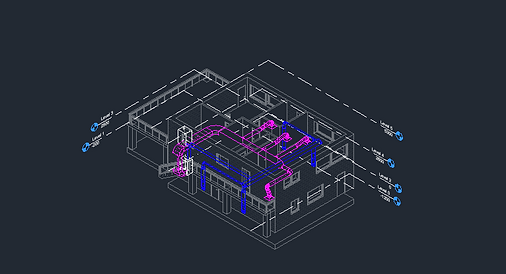
Figure 14: Duct re-design pt.1 in Revit
Proctor Prediction Neural Network
Author: Oliver Hale
Project Overview
Using Python with Pandas and TensorFlow, I created a neural
network that predicted the dry density/moisture curve using the Gradation data.

Figure 15: Proctor soil density test